“I realized my baby boy had lost his mind.” Advocate Jerri Clark Describes Her Journey To Help Her Son & Others

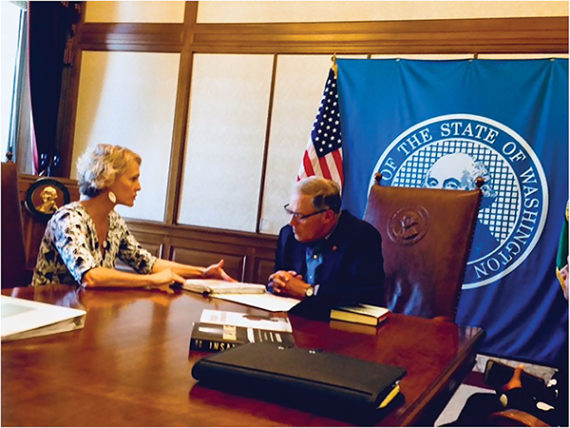
Jerri sat down with Washington Gov. Jay Inslee in 2018 to talk about gaps in the mental health care system. Courtesy Jerri Niebaum Clark

(11-17-21) This is part two of Advocate Jerri Niebaum Clark’s story about her struggles to help her son, Calvin, and how his death led to her advocacy.

Becoming A Parent Advocate: Part Two

By Jerri Niebaum Clark

First published in Kansas Alumni Magazine. Used by permission.

I remember a time when happiness and health felt normal. I left Lawrence, Kansas, and my position as an assistant editor for Kansas Alumni in 1995, newly married and five months pregnant. My husband, Matthew Clark, settled into a career with Hewlett-Packard. I became mother to baby Calvin and Michelle, 10 years older than he. I taught yoga and children’s ballet, work that blended well with parenting. We loved our Pacific Northwest home in Vancouver, Washington, where through the years we surfed off the Oregon coast and skied down Mount Hood.

Calvin became a state-champion debater and earned a scholarship to Willamette University in Salem, Oregon. Midway through his freshman year, he called in a rambling, tearful rant about being abandoned by fellow debaters. The details did not make sense. We brought Calvin home. Well past midnight, on February 16, 2015, I realized my baby boy had lost his mind.

Calvin’s speech was alarmingly disorganized and frantic. He did not sleep and was convinced a bathroom in our house was possessed and should never be entered again. A family doctor prescribed lithium. Calvin was at first relieved to have a diagnosis of bipolar disorder, like his paternal grandfather. This explained some of his confusion, so he agreed to take the medication. He got a job at the local farmer’s market selling cookies. He bought a Cookie Monster T-shirt. We were rearranged, but we were a family and happy to be together. There was even a magical day of surfing that spring when we all successfully caught overhead rides.

We came up for air, but the dangerous waves we would try to ride were just setting up. Events in the years to come tossed me around enough to reorder my understanding about what it means to be a parent, a compassionate person and an activist.

Click to continue…

“I saw clearly what was coming – I had no power to prevent any of it.” Advocate Jerri Clark’s Story About Her Son & Her Advocacy

Happier Times. Photo courtesy of Jerri Niebaum Clark

(11-16-21) Jerri Niebaum Clark embodies the famous Margaret Meade quote: “Never doubt that a small group of thoughtful, committed citizens can change the world; indeed, it’s the only thing that ever has.” 

My Son’s Journey: Part One

A Mom’s Journey Through Mental Illness, Suicide and Advocacy

By Jerri Niebaum Clark

First published in Kansas Alumni Magazine, University of Kansas.

I studied journalism with no idea that the most important story I would ever tell would be the tragedy of my own family.

My son, Calvin, was a happy baby, a solid student, a successful athlete. He grew into a clever, curious, compassionate person. He also developed a serious mental illness in his teen years that devolved into psychotic episodes. A mental health care system in disarray meant that instead of helpful care, our family met heartbreak.

In disbelief, I watched my son’s world tilt away from a bright future punctuated by academic accolades and toward incarcerations, suicide attempts and hospitalizations in locked wards that didn’t make him better. Along the way, the everyday bad news cycle got personal. I’m not at all surprised that homelessness and suicide rates are rapidly rising or that so many police encounters end tragically. These are preventable social ills, but our service systems are not built to prevent them.

Families like mine strive to keep loved ones from hitting rock bottom, discovering that there really is no bottom and that help doesn’t prevent but instead requires a radical free-fall. I watched my son delivered into society’s underbelly by design. He spent months homeless, met law enforcement again and again, and tried multiple times to die. These traumas are part of a tragic inventory of the requirements for public assistance when someone has a serious mental illness. Calvin was 23 when he died from suicide March 18, 2019.

As I try to reconcile what happened to my son and our family, I have been compelled to dust off my journalism skills to write and holler my way into public view.

Click to continue…

Off Medication: “I Fear He Will Kill Me!” Mother Says About Jailed Son

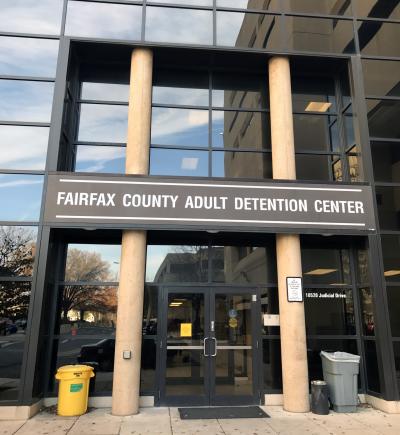
Fairfax County Photo

(10-25-21) This recent email made me ask two questions. Why wasn’t something done to help this young man before he was arrested? What can be done now to keep him from attacking his mother and further ruining his life? 

Dear Pete,

I find myself in a desperate situation.

My son is 28 with schizoaffective disorder. He did fairly well with his illness for many years while consistently on medication but spiraled downward in the last year and a half due to going off medication. He is currently in the Fairfax County Adult Detention Center for breaking a protective order against me.

After four attempts to have him hospitalized (two were successful but too brief), I finally had to get a protective order. Between late April and July he was trying to kill me. He kept trying to break into my house with knives and axes.

He was clearly suffering from voices or delusions telling him he had to do that. He no longer realizes that he is ill.

Click to continue…

Two College Students Took In A Homeless, Delusional Woman & Changed A Million Lives In India

Vandana Gopikumar

(10-15-21) If you ever have wondered if a single person can help change the world meet Dr. Vandana Gopikumar, co-founder of The Banyan, who was recently chosen as a Heroine of Health 2021 for her tireless advocacy on behalf of poor women with mental illnesses in India.

She is one of the most impressive leaders I’ve been fortunate enough to meet. Through her non-profit, she has offered hope and help to more than one million women in India and Sri Lanka.

In 2016, Dr. Gopikumar invited me to speak in Chennai, India, at a three-day Conference on Justice and the Rights of Homeless Persons with Mental Health Issues. I described how American jails and prisons have become our nation’s largest de facto public mental facilities and why that is wrong.

I learned much more from her than what I had to offer at the conference. She and her team arranged for me to visit three of The Banyan’s housing programs and speak to the women residents there. These women had been literally thrown away by society. They were homeless, destitute and delusional before they became part of the The Banyan. Most would have died in the streets. When I met them, they were smiling, well-cared for and busy making different types of clothing for sale to support themselves and The Banyan.

The story behind this amazing program is truly inspirational.

Click to continue…

Mother Says Son Finally Is Getting Help He Needs: Iowa State Hospital Is Not A “Horrifying Place”

Iowa hospital established in 1873 has gone through many phases.

(10-13-21) I’ve always been frustrated by the never ending argument about which is better: community care or longer term care in state hospitals before discharge. What we need are accessible services that are appropriate to each individual’s need, whether that be in a community setting or more intensive hospital care.  Here’s an email that I received this week.

Dear Pete,

Two days ago, we had our first ‘on campus’ outside visit with our son at the Mental Health Institute in Independence, one of two state hospitals that we have in Iowa. He was excited, because it meant that we could bring him food and eat with him outdoors.  It was a two hour timeframe, so he also wanted to take us on a walk to show us around.  The residents go for walks on a pretty regular basis when the weather is good.

I’m writing because I recently had a chat with a candidate running for state office, and she said something that indicated she thought our Mental Health Institutes are terrible places. (I imagine this came from a significant amount of messaging from our prior Governor, Terry Branstad, prior to closing two of these facilities in 2015, in which he talked about them being old, run-down and providing substandard care. In addition, for quite some time, there has been a lot of discussion about how everyone is much better served, “in the community.”  It is not surprising that this candidate had a poor opinion of the MHI’s.)

I spoke with her to inform her differently, and that our son is currently receiving the best treatment that he has received since he first became sick in 2008, in a state hospital.  (One of only 2 remaining state hospitals here in Iowa – where we only have 64 beds for adults and 32 for children, so our ranking by the Treatment Advocacy Center is 51st, dead last in the country.)

Click to continue…

Does The Public Believe The “Criminally Insane” Can Recover And Deserve Mercy?

(10-4-21) Does the public believe a defendant judged by a court to be criminally insane can ever recover?

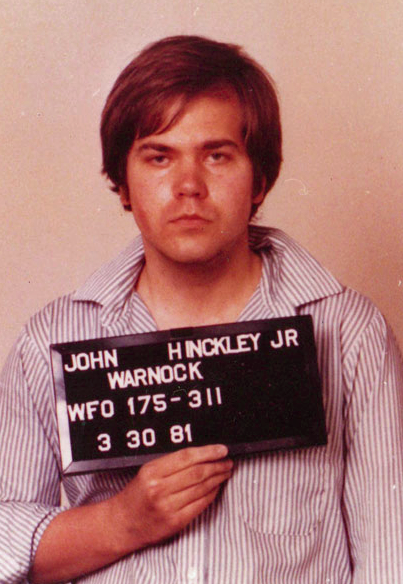
A federal judge recently ruled that John Hinckley Jr., who tried to assassinate President Ronald Reagan four decades ago, can be freed from all remaining restrictions next June if he continues to follow the court’s rules and remains mentally stable.

I clearly remember March 30, 1981 when Hinckley wounded Reagan, police officer Thomas Delahanty, and Secret Service agent Tim McCarthy. He also critically wounded Press Secretary James Brady, who was permanently disabled in the shooting and died from his injuries 33 years later. I was a young reporter at The Washington Post and assigned to write a story about the .22 caliber handgun and ammunition that Hinckley used.

Public furor over his Not Guilty By Reason Of Insanity prompted calls to rewrite the standards used for such pleas, and news that Hinckley now will be released after forty years, ignited another fierce debate.

Judge Paul L. Friedman said Hinckley, now 66, has displayed no symptoms of active mental illness, no violent behavior and no interest in weapons since 1983.

“If he hadn’t tried to kill the president, he would have been unconditionally released a long, long, long time ago,” the judge said. “But everybody is comfortable now after all of the studies, all of the analysis and all of the interviews and all of the experience with Mr. Hinckley.”

One individual who is not “comfortable,” is President Reagan’s daughter, Patti Davis, who wrote an OP in The Washington Post opposing Hinckley’s freedom. She strongly criticizing Hinckley’s attorney, Barry Levine, who she wrote: “worked the system from the beginning and, finding a judge who was sympathetic to them, made this day inevitable.”

Click to continue…