New Mental Health Czar Faces Huge Challenges In Focusing SAMHSA On Serious Mental Illnesses

mccance

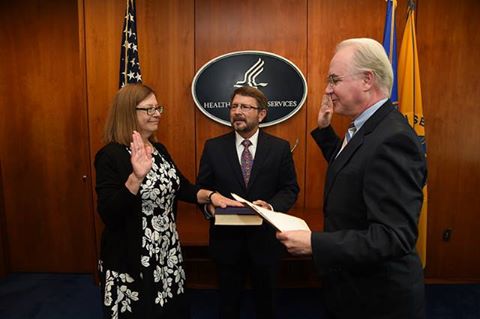
New Assistant Secretary for Mental Health and Substance Abuse is sworn in by Secretary Tom Price while her husband holds bible.

9-14-17) Dr. Elinore McCance-Katz, who was sworn in earlier this week as our nation’s first Assistant Secretary for Mental Health and Substance Abuse, is going to need a tremendous amount of support from families and mental health advocates if she is to change the course of the Substance Abuse and Mental Health Services Administration, a federal agency with a budget of about $3.6 billion a year, most of it dispensed in grants to help states pay for mental health and addiction treatment.

Reforming SAMHSA is the mandate that both Congress and the White House have given her, but the road to accomplishing that is filled with minefields.

She is taking charge at a time when SAMHSA has been under intense fire voiced during congressional hearings held by Rep. Tim Murphy’s (R.-Pa.) leading up to passage of the law during the Obama administration that created Dr. McCance-Katz’s new job.

But Rep. Murphy’s harsh critique was hardly the only voice clamoring for change.

For years, Dr. E. Fuller Torrey has lashed out against SAMHSA. Among his criticism: that SAMHSA failed to employe a single psychiatrist, funded groups that were outspokenly anti-psychiatry and anti-medication, and issued a three year planning document that was 41,804 words in length but didn’t include a single mention of schizophrenia, schizoaffective disorder, bipolar disorder, autism or obsessive disorder. Instead, he said, SAMHSA frittered away millions on feel good programs for the worried well. As an example, Rep. Murphy and Dr. Torrey cited SAMHSA’s funding of an “Unleash the Beast” program that promised to help attendees learn about mental illness by studying animal movements.

Even SAMHSA’s own employees were unhappy. A 2015 study by a non-partisan watchdog group ranked SAMHSA at 317 out of 320 federal agencies when it came to employee job satisfaction.

Among the SAMHSA’s harshest critics was Dr. McCance-Katz herself.

In an earlier incarnation, Dr. McCance-Katz served as SAMHSA’s first chief medical officer but left after only two years. Once out the door, she blew the whistle on SAMSHA, writing in an April 2016 Psychiatric Times article that at SAMHSA:

 There is a perceptible hostility toward psychiatric medicine: a resistance to addressing the treatment needs of those with serious mental illness and a questioning by some at SAMHSA as to whether mental disorders even exist—for example, is psychosis just a “different way of thinking for some experiencing stress?”

All of which, now begs a question that needs to be answered.

Changing the top leader at a federal agency doesn’t change the career employees who have been sailing the ship for the past decade.

Click to continue…

A BIT TOO MUCH ABOUT ME: New York Show Explores Creative Bipolar Mind – And How A Social Worker Helped My Family

zacshow

(9-12-17) My good friend, Steve Weiss, recently asked if I would help publicize A BIT TOO MUCH ABOUT ME, a performance by Zac Sandler. The show is being performed this coming Friday, September 15th, beginning at 7 p.m. at The Triad Theater,  158 W 72nd Street, New York City. (It also will be live streamed, details below.) If you live in the New York area or happen to find yourself in Manhattan, please check it out.
What’s the show about?

“Welcome to what’s inside Zak’s head.  From the piano, Zak narrates his experience with a serious mental condition as it progresses from out-of-control to chaotic, to in-control and harmonious, while he strives to navigate his relationships and his writing career.  Joining Zak is a group of actors who play younger Zak, his exes, and the parts of his brain that come out during his mental episodes.”

I am especially pleased to be plugging this performance.

My friend, Steve Weiss, whose recommending the show, has been someone who has unselfishly helped my family numerous times during crises.

HOW STEVE WEISS HELPED MY SON WHEN THE POLICE WERE CALLED

After my book was published, Kevin stopped taking his medication. I called a mobile crisis response team and explained that I was concerned because I could see Kevin was beginning to slip into psychosis.

Is he dangerous?” the dispatcher asked me.

Click to continue…

When A Hurricane Threatens, We Decide Homeless, Seriously Mentally Ill Need Help Against Their Will, But Abandon Them In Good Weather

ct-miami-homeless-removed-irma-20170908-002

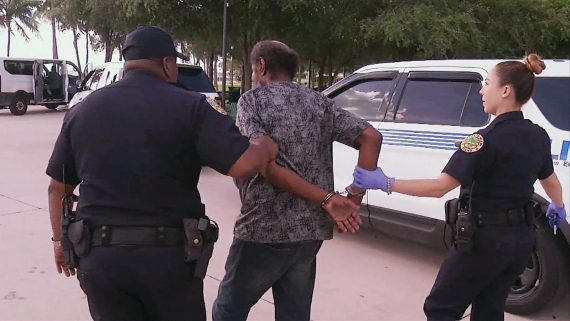
It’s disturbing to see individuals with mental illness handcuffed and led away. Thankfully, they were taken to a crisis stabilization unit and not jail. 

(9-9-17) My good friend Miami Dade Judge Steven Leifman and his family have evacuated from Miami but not before he spoke to community leaders about the city’s seriously mentally ill, homeless population. 

 In an email, the mental health advocate told me: “These individuals were transferred to Jackson Memorial Hospital’s Crisis Stabilization Unit – they were not sent to an inappropriate shelter. We also coordinated with Jackson so they were prepared to handle the increased volume.”

Douglas Bevelacqua, a former IG for mental health in Virginia, noted in an email to me, “Hurricane Katrina raised everyone’s consciousness about the plight of companion animals during, and after, a major storm. There are many organizations and programs to help save and reunite dogs and cats with their owners. I wonder if Houston’s mentally ill street population is getting a fraction of the attention directed to its companion animals.” Bevelacqua wonders if  the National Alliance on Mental Illness, Mental Health America, or some other mental health group will sponsor or participate in a national disaster relief fundraiser. Good question.

During emergencies, everyone realizes many homeless individuals are so impaired by their brain disorders they cannot make rational decisions to protect themselves. But when the sky is clear, society is fine leaving them to fend for themselves on the streets.)

Miami shelters homeless against their will as Irma closes in

By Adriana Gomez Licon
Associated Press, reprinted from the Chicago Tribune

On what is likely the last clear day in Florida before Hurricane Irma‘s monster wind and rain, social workers and police officers are giving Miami’s estimated 1,100 homeless people a stark choice: Come willingly to a storm shelter, or be held against their will for a mental health evaluation.


Click to continue…

When Does An Illness Become A Serious Mental Illness? And Does Our Definition Divide Us?

 homeless teens
 (9-7-17) My friend, psychiatrist, author and blogger, Dr. Dinah Miller, posted a blog at Shrink Rap yesterday that asks what is and isn’t a serious mental illness? She is the co-author of  COMMITTED: The Battle Over Involuntary Psychiatric Care.)

Friends in High Places: thoughts about SMIs

By Dinah Miller

Move over, there’s a new federal mental health committee in town.  The department of Health and Human Services has formed the Interdepartmental Serious Mental Illness Coordinating Committee My friends Pete Earley and Elyn Saks are both on the committee, and Pete has been blogging about the committee for a couple of weeks now– the good, the bad, the ranting, and the missed opportunities after the first day of meetings last week.

You’ll be pleased to know that I didn’t miss the opportunity to put in one of my concerns: I emailed Pete and Elyn to tell them how pre-authorization for medications is having a negative impact on the practice of   medicine, and psychiatry in particular.  Nothing new, but it’s a topic that every medical organization has been fighting for years and nothing ever gets done, so I thought I would ask that it be brought up again.  My thanks to Pete for including my concern on one of his blog posts.

When people talk about serious mental illness (SMI), I always have the same reaction: What is it? 

From what I can tell,  one gets the designation with a diagnosis: schizophrenia or bipolar disorder or severe depression.  Apparently it’s not about illness chronicity or impairment, or spending time in institutions, or whether an illness responds to treatment.
I’m always at a loss: as  I’ve said before, our diagnoses are not precise, prognoses can be wrong, and people can be very sick at one point in time and very well at others.  So while 1 in 8 adults are on SSRI’s, 1 in 5 suffer from an episode of mental illness during the course of a year, and half of us will have an episode of mental illness during the course of a lifetime, these people with serious mental illness are quite few: 4.5 million Americans.  I wish these people wore signs so we knew who they were and could divide the resources appropriately.

Click to continue…

Co-Founder of This Is My Brave Passes. “HOPE” – Hang On, Pain Ends.

mm-jennifer-marshall-partners

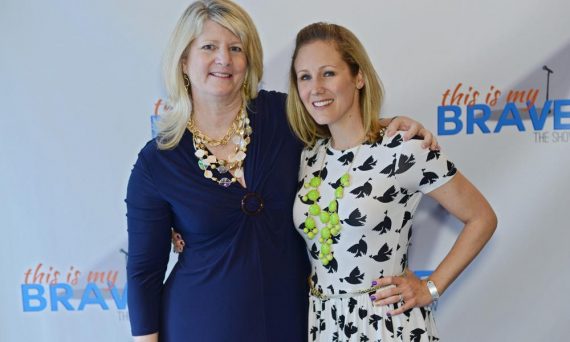
Anne Marie Ames and Jennifer Marshall

(9-6-17) My good friend and fellow mental health advocate, Jennifer Marshall, best-known for launching This Is My Brave, lost the organization’s co-founder last week. Here is the tribute that she wrote about Anne Marie Ames.)

A Tribute to our Co-Founder, Anne Marie Ames

By Jennifer Marshall, reprinted from THIS IS MY BRAVE webpage

My heart is shattered into a million pieces.

How could I have let this happen?

I wish I would have loved her better.

I wasn’t ready to say goodbye.

Those were the first thoughts and feelings that rushed over me like a wildfire after it happened. I found out about Anne Marie’s passing through a call from Michelle, one of her closest friends and neighbors.

How we all wish we could have said goodbye.

Within minutes, Michelle was at my doorstep where Ben and I had been holding each other in shock.

Anne Marie was one of my best friends for the past four years. As some of you know, we met at a jewelry party hosted by Kiran, where the running joke after that night was that Anne Marie and I had fallen in love talking for two hours in a corner where no one could interrupt us.

It was the truth.

Click to continue…

Top Federal Officials Missed An Opportunity To Send A Powerful Message About Mental Illnesses

BOARDS_COMMITTEES

(9-4-17) Health and Human Services Secretary Thomas Price called serious mental illness a “silent epidemic” that touches nearly all Americans. Housing and Urban Development Secretary Ben Carson agreed. But where were their peers when the Interdepartmental Serious Mental Illness Coordinating Committee (ISMICC), created by Congress, held its first meeting last week?

The 21st Century Cures Act stated that these top federal officials would be members of the committee.

Attorney General Jeff Sessions.

Secretary of Veterans Affairs David J. Shulkin.

Secretary of Defense James Mattis.

Secretary of Education Betsy DeVos.

Secretary of Labor R. Alexander Acosta.

Commissioner of Social Security Nancy A. Berryhill.

I know I am nitpicking. All of these leaders work grueling hours and simply can’t be everywhere the public would like them to be. Plus, they sent senior officials from their agencies to represent them, many of them mental health experts.

But the Trump Administration missed a opportunity by not having its elite leadership team appear at the inaugural meeting, even if it were only long enough for a photo. (See photo at end of this blog showing those who did attend.) Each agency also should have issued a press release on the day of the meeting issued by its top executive addressing how their agency is working on improving mental health services and is reducing stigma within its own ranks.

Consider the powerful, positive message their appearances would have sent to the public and to the federal employees who work in their agencies.

Last week, I posted Secretary Price’s impressive opening statement and in this blog, I will share Dr. Elinore McCance-Katz’s important remarks to the committee.

But first a personal observation. When Secretary Price arrived at the meeting, he spoke to everyone in the room, asked their names, and shook their hands. Unfortunately, Secretary Ben Carson arrived at the last minute and left immediately after he spoke so he was unable to greet everyone.

When I worked at The Washington Post, I spent several weeks traveling with Archbishop Desmond Tutu. He made a point of introducing himself to every doorman, every food server, and the housekeeping staff when we traveled, at times, he did this before greeting dignitaries. I never forgot the visual statement it made: you are important regardless of whether you are the head of a great university or a janitor. You matter.

You might not agree with Secretary Price’s politics, but he showed tremendous class when he arrived at the meeting and took time to introduce himself and shake hands.

As for the others, they missed an important moment when they could have done tremendous good simply by showing up for a picture.

Remarks by Assistant Secretary Dr. Eleanor McCance-Katz

Thank you Secretary Price.

  • In my role as Assistant Secretary for Mental Health and Substance Use, I am pleased to pledge the support of SAMHSA to the Secretary’s priority issue related to Serious Mental Illness. As many of you know, SAMHSA is the agency within HHS that is charged with leading the efforts to address behavioral health issues, such as SMI and SED in our country and I look forward to the work of this committee in helping SAMHSA to address this mission.

Click to continue…