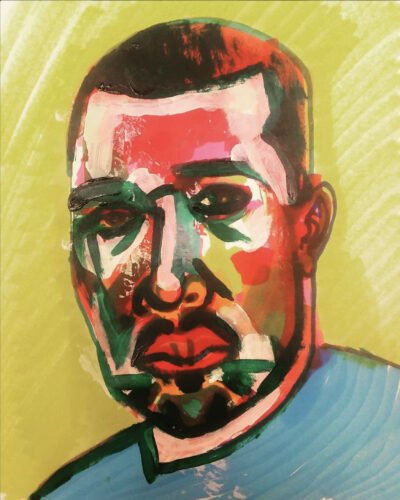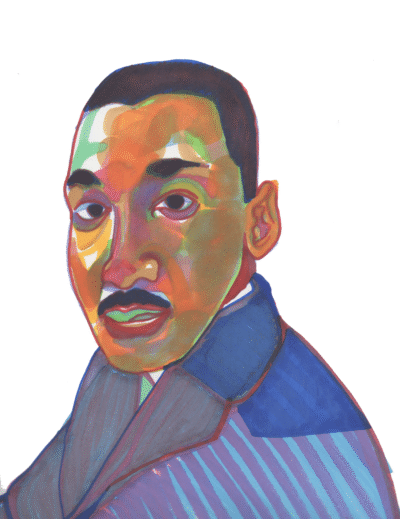
(drawing of MLK Jr by the Author)
“We are caught in an inescapable network of mutuality, tied in a single garment of destiny. Whatever affects one directly, affects all indirectly.”
- Martin Luther King, Jr.
LOUD VOLUME
A lot is going on these days. Recent events in Minnesota have seemed to raise the volume on an already loud conversation. Today is a general labor strike against these abhorrent actions of ICE officials. Being snowed in, which usually gives us time to rest, refresh, and recalibrate, has only seemed to give us more time to ponder the injustices that have been occurring for a while now. People are protesting, boycotting, and marching against injustICE. Again. In the month where typically we honor Martin Luther King Jr’s birthday and the federal holiday associated with it, things are happening.
MUTUALITY
We live in a web of mutuality. I am another you, you are another me. What happens to you affects me and vice versa. Early civilizations relied on each other. When one member of a tribe suffered a devastating broken femur, they were not simply abandoned and forgotten about; other members stayed with, assisted, and helped the one with the broken femur recover. While there is certainly competition in society and nature, there is also cooperation.
This narrative runs counter to ideas about “selfish genes”, “winners versus losers”, “survival of the fittest”, “rugged individualism”, and mantras like “greed is good”. While wealth inequality is now higher than it was during levels of the Gilded Age, there are those still resistant to the ideas of mutuality and assisting those less fortunate. I was reading about what some religious folks are describing as “the sin of empathy,” and it made me concerned for our collective humanity.
I believe that actions and deeds are not necessarily “sinful”, but take place upon a spectrum, where some of them are good, well-natured, and beneficial to self, and other deeds are detrimental, selfish, and against the common good. Of course there are extreme actions, like murder and violation, that are universally seen as wrong throughout civilizations, but there also exist all the permutations in between those two sides of the spectrum. One bad action, while it may be repugnant and shameful, may be redeemed by future actions. Like Miles Davis once said, “It’s not the note you play that’s the wrong note—it’s the note you play afterwards that makes it right or wrong.” Just as one bad deed can be redeemed by a good deed. Obviously, there are limits to this though.
PUNISHMENT
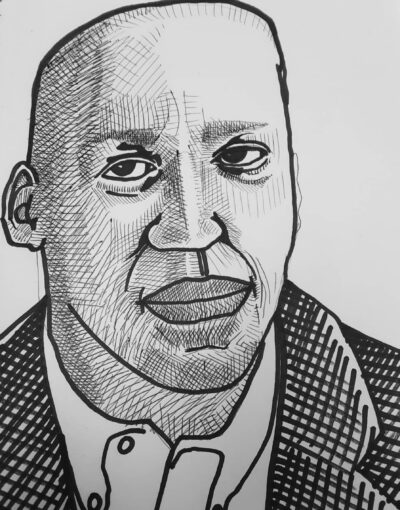
(drawing of Bryan Stevenson by the author)
This brings us to punishment. I don’t believe punitive measures are constructive, especially in a justice system with so much blatant racism and disparity as our current one. Punitive measures foster shame; they foster defining a person by one single incident, when we all contain multitudes. My father interviewed Bryan Stevenson, who famously said, “Each of us is more than the worse thing we’ve ever done”.
“If someone does something that is deemed “wrong” or violates the common good, focus on the next “note” and help them make sure the next note they play is productive and beneficial. Don’t shame someone; encourage them to be better, lead through example, not through violence.
As far as the “sin of empathy”, I beg religious folk to consider the story of the good Samaritan or even the actual teachings from the sermon on the mount, by the man many claim to follow, but seem to know little about. Empathy is not a “trap”, but a human experience that allows us to foster connections, not simply use others as ways to hold ourselves in a higher regard.
EMOTIONS
I know that many people with severe mental illnesses can be described as “too emotional”. We are sensitive people; sometimes we are “too sensitive” or “too emotional”, or we are deemed that way. What does that mean exactly? Is there such a thing as too much empathy? Can someone be too kind, too sensitive, or too emotional for this world? People talk about having “tough skin” and “bucking up” as a way to encounter the world and move through it in a way that allows you to operate without being “too emotional”. Especially as men, we are taught to suppress and hide our sensitivities, if not for our own sake, for the sake of others who are doing the same unspoken sacrifices and cringe at our empathy.
Would the world cease to revolve if the men were “too sensitive”? What power structures and societal organizations thrive on a numb, pacified populace that doesn’t feel empathy for the pain it inflicts? Could we raise “good” soldiers, company men, and rule followers if we were too empathetic? How much of the pain and injustice in the natural world do we have to tune out to survive in this society?
I take medication every day to function in this society. I often think of R.D. Laing’s quote, “It is no sign of sanity to be well adjusted to a sick society”. I think of Dr. Martin Luther King, Jr.’s comment about how he feared he “may have integrated his people into a burning house”. I wonder about this society, especially as I watch recent current events on television. Are we all living in a “burning house”?
I still have my moments and my issues, as I am human and not a machine. I have been to laboratory clinics in big pharmaceutical industries where they manipulate the receptors of dopamine in rodents. I have seen maps of rodents’ brains and had the process of how these medications I take explained in great detail to me. Despite all of this, I still don’t really understand how they work exactly.
I just know, through my lived experiences, that when I was off my medications, I would end up in fights, arguments, crying spells, emotional outbursts, paranoia, and altercations with police that resulted in hospitalizations. When I am on my meds, none of that seems to happen. I had a proven track record on and off my meds. I couldn’t argue with the results. Sometimes I feel guilt for being “well-adjusted” to this society, especially as long-held societal roles and norms are challenged and eroding in real time with the current political climate. What does it mean to be “well-adjusted” to a sick, cruel society that shuns empathy? What does it mean to integrate into a “burning house”?
MARCHING
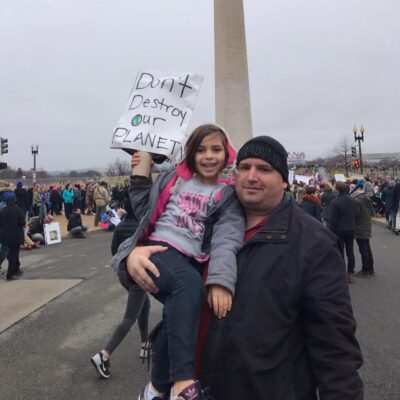
(Author with family member at 2017 Women’s march.)
I think of my brother, whom I look up to. Years ago, during the Black Lives Matter movement in popularity, we were going to a march. He had been on several that year, so I asked him, “How many marches will you be going on?”
He replied, “As long as there is injustice, I will march!”, to which I replied, “Steve, there will always be injustice…” He looked at me and shrugged.
So the marches continue.
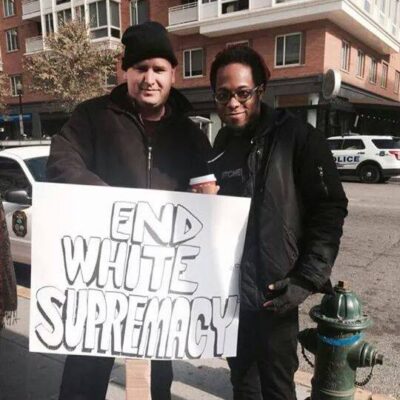
(Author with friend at 2014 BLM march in D.C.)