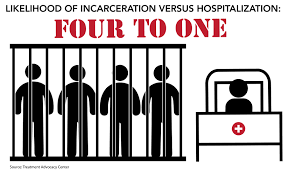
“Two months in jail and put back out the streets.  At least he was fed at the jail.”

Photo by Dev Asangbam

(11-25-19) Anyone who advocates for persons with mental illnesses quickly begins receiving emails and telephone calls from desperate families seeking help. In Montana, those pleas end up being directed to Dr. Gary Mihelish, a recipient of the highest award given by the National Alliance on Mental Illness -its’ Distinguished Service Award.  I am posting this recent exchange between Dr. Mihelish and a Montana family NOT because it is extraordinary but because it is so common. 

11-14-19
Hi Gary,
I thought I’d give you a quick update about my brother who is in jail.

The Center for Mental Health said they are willing to work with him but all we got back from them is a big stack of paper work to fill out. Upon seeing the papers and remembering that they basically fired my brother as a client several years ago (I’m not saying it was unwarranted-but that he’s been with them before) we called Aware. (A mental health provider.) The woman there was very nice and helpful and she is going to try to get my brother to consent to work with them. It sounds as if they have great resources and at the very least if they could help with the payee work then my mom wouldn’t have to be the one giving him money.

We are crying tears of joy because someone offered us a ray of hope by saying they are willing to help and to not give up on my brother. You can’t believe how important and how good it feels just to have someone say they are willing to help and to tell us don’t give up.
As it stands now Aware is going to try to get my brother to agree to work with them. It’s the first sign that something may get done.

Click to continue…

“I’ll Do It” Spirit Cited At Advocate’s Memorial, Challenging Others To Serve Their Communities


(11-22-19) A close friend of long-time mental health advocate Betsy Greer urged those attending her memorial service yesterday to adopt Betsy’s “I’ll Do It” mantra.

I noted Betsy’s death and tireless efforts to improve the lives of those with mental illnesses, primarily through the National Alliance on Mental Illness, in an earlier blog. Acting NAMI CEO Angela Kimball and long-time NAMI advocate Bob Carolla spoke eloquently about their memories of Betsy. In addition to being honored by NAMI, a sign of her importance in her home state of Virginia was that Mira Signer, chief deputy commissioner of the state behavioral health department, was in attendance.

Betsy’s good friend, Rayna Aylward delivered a eulogy that should inspire all of us.

TRIBUTE TO BETSY GREER,

Rayna Aylward 11/21/19

     Betsy was an exceptionally smart and articulate person, and an accomplished writer and public speaker.   But the words I most remember from her are just three simple ones:     I’LL DO IT

    If there were something that needed to be done, or someone who needed to be helped, Betsy would say:  I’LL DO IT

    Betsy and I were longtime members of the Kol Ami congregation, but I didn’t really get to know her well until about two years ago, when I joined the Kol Ami Care & Concern Committee, which focuses on supporting members in times of need.  

Click to continue…

A Hoax? Questions Raised About Famous 1970s Study That Found Doctors Eager To Hospitalize Sane Patients Faking Schizophrenia

(11-18-19) In 1973,  Dr. David L. Rosenhan, a professor of psychology at Stanford University, announced that he and seven others had pretended to have a serious mental illnesses and were subsequently hospitalized and diagnosed with schizophrenia even though they were faking.

His report, On Being Sane In Insane Places,  published in Science, the journal of the American Association for the Advancement of Science, shocked the country and deeply weakened the public’s faith in psychiatrists, state mental hospitals, and psychiatry itself.

The article has been embraced for decades by the anti-psychiatry movement as proof mental illnesses are a “social construct” and do not exist. His study  “plunged the field into a crisis from which it has still not fully recovered,” the New York Times recently noted. “It made Rosenhan an academic celebrity. Nearly 50 years later, it remains one of the most cited papers in social science.”

Dr. Rosenhan, who died in 2012, claimed that three psychologists, a pediatrician, a psychiatrist, a painter and a housewife, joined him in posing as patients. None of the other pseudo-patients was identified in his article, which he intended to publish as a book, nor were the doctors and hospitals that were bamboozled named.

It now appears his study might have been a hoax.

Click to continue…

Advocate Encourages Doubters To Use Jail Form To Meet With Sheriff’s : “Get Involved! Organize!”

Doctor Filling Syringe in Prison

(11-15-19) Earlier this month, I posted a blog entitled: Advocate Creates Medical Form & Handbook Telling You What To Do If Someone You Love Is Arrested.  It offered readers a sample form that could be used to inform jail officials about the medical needs of someone who has been arrested. Mark Gale, who created the form, also prepared a handbook that described what needed to be done in the Los Angeles area if someone was jailed.

Dear Pete,

I want to follow up on your blog. I agree with several readers who commented on your Facebook page that there are far too many jails across our nation that either do not deliver medications and treatment, or simply ignore their constitutional obligation to provide at least a minimal adequate level of health care to all who are detained.

Their cynicism and frustrations are well-founded, but they don’t solve the problem.

My message to them is “Get Involved! Organize!”

The Inmate Medication Information Form is not just a well-intentioned informational form to assist clinicians with continuity of care, it is a well-defined simple advocacy tool that can be used to begin a dialogue with the Sheriffs and Custody Commanders who run your local jail.  You are being handed a reason to call for a meeting.  Don’t pass up the opportunity.

Click to continue…

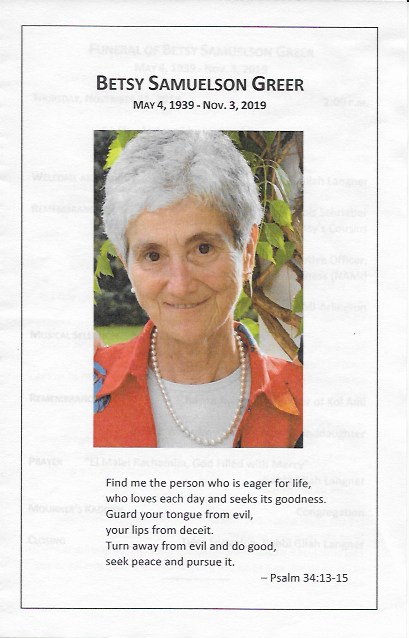
NAMI Activist Betsy Greer Remembered As Fierce Advocate For Individuals With Serious Mental Illnesses

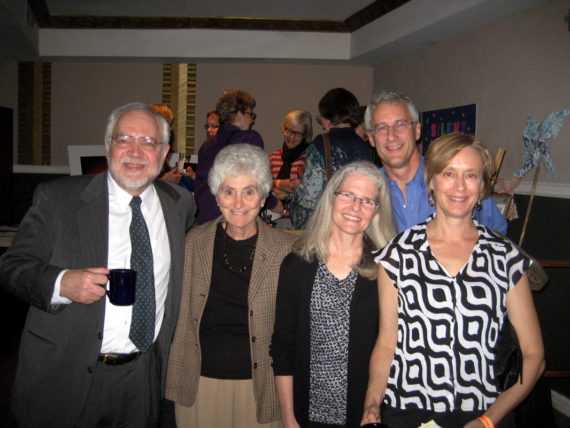
Betsy Greer, second from left in brown pants and vest, celebrating with Northern Va. NAMI friends before her illness.

(11-8-19) Activist Betsy Greer is being remembered as a dogged advocate. She died Sunday after battling cancer for more than a year.

When we first met in 2006 after my book was published, she described herself as a ‘troublemaker.” That was how she viewed her role. She was relentless in pushing elected leaders, government agencies, mental health providers and advocacy groups to do more to help persons with mental illnesses. When others said, “It can’t be done,” Betsy demanded to know why before setting out to prove them wrong.

Much of her ‘troublemaking” was done through the National Alliance on Mental Illness. Along with her late husband, Richard, she co-founded the NAMI chapter in Arlington. Together, they worked tirelessly to help put NAMI on a strong footing in the Washington D.C. area.

Richard and Betsy were journalists, and she often used a her investigative reporter’s skills to cut through fluff and tackle problems locally and nationally.

Fellow Arlington advocate and friend, Naomi Verdugo, in an email described how Betsy helped her.

Click to continue…

Advocate Creates Medical Form & Handbook Telling You What To Do If Someone You Love Is Arrested

EVERY NAMI AND MHA GROUP IN OUR COUNTRY SHOULD CUSTOMIZE THE MEDICAL FORM MENTIONED IN THIS BLOG AND BEGIN USING IT! LOCAL CHAPTERS SHOULD ALSO PRODUCE A MANUAL THAT GUIDES PARENTS AND OTHERS ABOUT WHAT TO DO IF SOMEONE THEY LOVE WITH A MENTAL ILLNESS IS ARRESTED IN THEIR LOCAL JURISDICTION. 

(11-4-19) Mark Gale became alarmed when his son was arrested and jailed in Los Angeles’ Twin Towers.  He wanted the correctional officers to know that his son had a serious mental illness and what medications helped him.

But there was no obvious way for him to communicate his son’s diagnosis or his background to those who were guarding him.

Although Mark was on vacation, he began calling the jail. For five straight days he called. He either was put on hold or was passed from one person to the next for five hours each of those days. Finally, he  reached someone.

Mark wondered if other families would have the determination to do what he had done or know how, so he decided to create a family friendly form that could be faxed to the jail staff and also write a handbook that contained helpful information that families needed to know whenever someone they loved was arrested.

Click to continue…