How Do We Get Josephine Off Skid Row? Community Treatment Isn’t Working & She’s Suffering

Tenting in Downtown Los Angeles, Skid Row | Russ Allison Loar/Flickr/Creative Commons

(5-3-21) How do you help someone who is addicted, seriously mentally ill and living on the streets in Los Angeles’ Skid Row?

Today’s guest blog comes from Dr. Susan Partovi, MD, who has been helping those on skid row streets in Los Angeles for more than 17 years and is the Medical Director for Homeless Health Care LA.

I would argue that she is more familiar with the problems and what needs to be done than most us, including directors of mental health organizations, civil rights lawyers in Washington D.C., and politicians drafting legislation. As of a 2019 count, the population of the Skid Row district was 4,757. Skid Row contains one of the largest stable populations (about 4,200–8,000) of homeless people in the United States 

She needs to be heard. 

Meet Skid Row’s Josephine

By Dr.  Susan Partovi

Josephine is a drug user on skid row in her early 40’s with bipolar disorder. This means that she often has episodes of psychosis.  She often trades sex for her drugs which has left her open to the savages of that lifestyle.

Since I first met her, she has become blind because she once was hit so hard that her retinas detached. She has acquired HIV. She often sees me for STD symptoms. Last week, I saw her with a huge bruise on her face. Her jaw looked broken. Sometimes I see her completely psychotic speaking in an unintelligible language. She sometimes comes in irate yelling at whomever and we calm her down. She has been hospitalized frequently for danger to self or danger to others and in and out of jail.

Click to continue…

Biden’s Pick For SAMHSA Opposed AOT In 2018 Interview: “We don’t want to perpetuate that in the treatment system.”

(4-28-21) In a 2018 newspaper interview, President Joe Biden’s nominee to become the new Assistant Secretary for Mental Health and Substance Abuse opposed Assisted Outpatient Treatment.

I wrote on Monday that Dr. Miriam E. Delphin-Rittmon will have to navigate between opposing views in charting SAMHSA future, including AOT. Her predecessor pushed for greater use of it but AOT often is strongly opposed by those with lived experience and peer organizations.

A reader sent me a 2018 newspaper interview with Dr. Delphin-Rittmon that was conducted after the Treatment Advocacy Center, which lobbies for more use of AOT, gave her home state of Connecticut a ‘failing grade.’ It is one of three states that don’t authorize use AOT.

It’s likely Dr. Delphin-Rittmon will be questioned about AOT when the Senate Health, Education, Labor and Pensions Committee conducts her confirmation hearing. (You can check its membership and schedule here.)

Click to continue…

Which Path Will Biden’s Nominee To Run SAMHSA Choose? Agency Has Swung Between Anti-Psychiatry & Pro Assisted Outpatient Treatment

(4-26-21) President Joe Biden’s nominee to run the federal government’s mental health and substance abuse programs is largely unknown in Washington D.C. among mental health leaders.

Biden announced on Friday (4-23-21) that he’d chosen Dr. Miriam E. Delphin-Rittmon to be the next Assistant Secretary for Mental Health and Substance Abuse. She currently serves as the Commissioner of the Connecticut State Department of Mental Health and Addiction Services. If her nomination is approved by the U.S. Senate, she will take charge of SAMHSA, with a $6 billion budget, much of which is distributed through block grants to states.

As SAMHSA head, she will spell out priorities for that agency during the next four years.

Asked over the weekend for comments, several leaders of major mental health organizations, replied that they had heard “good things” about the nominee from their members and other contacts in Connecticut, but few had dealt personally with Dr. Delphin-Rittmon.

An exception was former Assistant Secretary Dr. Elinore McCance-Katz, who the nominee will replace.  They worked together at SAMHSA during the Obama Administration. Dr. Delphin-Rittmon spent two years there, according to her official resume released by the White House.

“I met Miriam when I came to SAMHSA as the Chief Medical Officer and she was a Senior Adviser. I liked her very much. She is bright, knowledgeable, and a very nice person. I don’t know what direction she will take as the Assistant Secretary, but I am confident that she will be dedicated to working on behalf of Americans with mental and substance use disorders.

Click to continue…

Mentally Ill Americans Not Being Vaccinated, Plus Documentary Questioning If Community Care Is Enough?

Image by torstensimon from Pixabay

(4-23-21)  Three items worth your time.

  1. Two national mental health advocates warn that Americans with serious mental illnesses are not getting vaccinated and a “schizophrenia diagnosis is the second largest predictor of mortality from COVID-19, after age.”
  2. Arlington Va. advocates gain an ally in pushing for Coordinated Specialty Care (CSC) for those with early episode psychosis (or First Episode Psychosis).
  3. “If you tried, you couldn’t create a worst mental health system than what we have today,” claims Dr. Steve Seager in a powerful documentary that shows how our rush to close state hospitals has increased incarceration, homelessness, deaths and the abandoning of 350,000 on our streets. Featured in this film, which I missed when it was first released, are frequent guest bloggers on my page – Laura Pogliano, Teresa Pasquini, Susan Inman and the late D. J. Jaffe.

Click to continue…

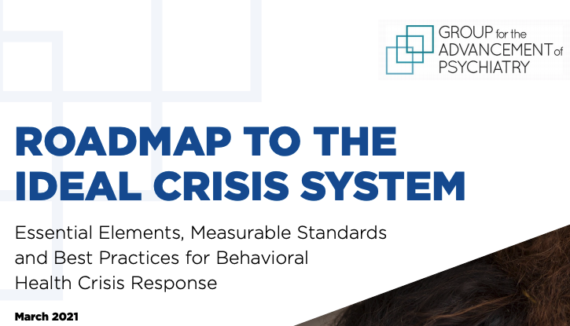
“Groundbreaking” Report Shows Steps To Create An Ideal Crisis Care System In YOUR Community

Courtesy of Gary Blau PHD

(4-20-21)

In most American communities today, the behavioral health crisis system isn’t really a system at all, but a combination of services provided by law enforcement and hospital emergency rooms that are typically not designed to meet the needs of individuals in the midst of behavioral health crises,

So begins Roadmap To The Ideal Crisis System, a much-anticipated, recently released report written to provide advocates, local leaders, and your community with a step-by-step blueprint that shows how to create an “ideal system.”

The 208 page report – yep its thorough – leaves no aspect of crisis care uncovered. It was spurred, in part, by Miami Dade Judge Steven Leifman’s request for a practical guide that communities could use that would explain what an ideal system looks like and how to go about implementing one.

That was a daunting challenge.

The timing of the report is important because in 2022, the nation is scheduled to replace its national suicide hotline number with a much broader crisis hotline number – 9-8-8. In anticipation of the 9-8-8 switch, the report’s authors are urging communities to review what services are currently available and begin implementing its recommendations for forging an “ideal” system.

The report explains how 9-8-8 hubs can be used as an entryway into services where callers are triaged by specially trained experts capable of connecting them to crisis care services best suited for their individual needs – whether the caller is experiencing suicidal thoughts or is having a mental health or drug crisis.

Called “groundbreaking” by the National Council for Behavioral Health, the report spells out how “to design and implement a mental health crisis system and demonstrates how a community’s response must be fully integrated with the treatment system.” Read the full report or read the executive summary.” The council, which represents mental health providers and is pushing the report’s recommendations, states:

The comprehensive new report attempts to address every point in the continuum of crisis services. And because it is the first report of its kind, this blueprint will serve a vital role for any community that is planning its crisis system. With 9-8-8 fast approaching, it’s time to begin the work to plan, design and implement that system of care so the resources are in place when people call for help.

To help politicians, advocates, and legislators, the report includes a Report Card for grading your community. A section of the report also lists its recommendations for reducing reliance on police as first responders during mental health and drug crises.

Click to continue…

Advocate Says Arlington County Va. Could Finally Fulfill John F. Kennedy’s Mental Health Call

The arrival of Amazon’s east coast headquarters will give Arlington County a boost. Will county officials make Arlington a mental health showplace as well?

(4-14-21) Long-time Advocate Bob Carolla argues today that Arlington County, Va., could become a state and national showplace in providing community mental health care through a host of innovative programs. Will public- private partnerships help achieve the vision?

Arlington, Va–A New Frontier for Mental Health Care?

By Bob Carolla

Looking east, Arlington, Virginia is a gateway to the nation’s capital. Looking west, it is a gateway to a growing high tech economy.

It’s also home to an eternal flame that burns on a hill at the gravesite of John F. Kennedy in Arlington Cemetery: a symbol of the idealism of a New Frontier and an unfinished presidency. Part of his unfinished vision is available, accessible and excellent community based mental health care. Unfortunately the 1963 Community Mental Health Act remains a largely broken promise. Today, we have an inadequately treacherously fragmented, mental health care system that includes a yield of chronically ill homeless persons.

Arlington, where I live, currently is poised to fulfill President Kennedy’s vision.  Here’s steps that could help it accomplish that goal.

Click to continue…