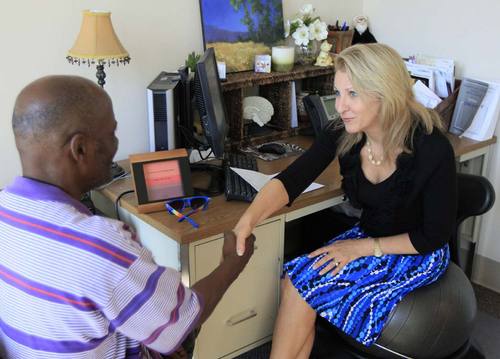
My friend, Dr. Tracey Skale, the chief medical director at the Greater Cincinnati Behavioral Health Services, was interviewed by a local television channel in Cincinnati about violence and mental health services. I’ve been traveling for several days and only now was able to watch the half-hour interview on NEWSMAKERS . Dr. Skale made several key points:
1. While the majority of persons with mental illnesses are not dangerous, those with severe mental disorders who are untreated, are more likely to commit violent acts than the general population.
2. Mental illnesses are exactly that and there should be no shame or stigma in having one.
3. While dangerous behavior is nearly impossible to predict, there often are warning signs such as a person being isolated or unconnected with others. The chances of identifying someone who might be violent are greater when psychiatrists spend adequate “face time” with their patients. Unfortunately, psychiatrists are being pushed for cost reasons to focus only on issuing medications rather than actually getting to know their patients.
5. While risk assessments are done when patients first are interviewed, there often are no updates or follow-up reviews.
The Wall Street Journal recently published an editorial by Dr. Lloyd Sederer, the medical director of the New York State Office of Mental Health and an adjunct professor at Columbia University’s Mailman School of Public Health, that pinpointed other problems in our mental health care system. Dr. Sederer criticized HIPAA (Health Insurance Portability and Accountability Act) for limiting the exchange of information between family members and doctors. He also complained about overly restrictive laws that limit the treatment of persons against their will.
Vice President Joe Biden met last week with the leaders from major mental health organizations, such as NAMI. It’s executive director Mike Fitzpatrick released a list of NAMI’s priorities.
I’ve been disappointed in the sort of legislation that is being proposed because of the Sandy Hook shootings. The legislative bills that I’ve seen in various state legislatures call for drawing up lists of persons with mental disorders to make certain persons with mental health backgrounds can’t buy or own guns. Such laws will further stigmatize persons with illnesses.
We don’t need lists. We need improved and better-funded community mental health services. We need a national dialogue about our existing mental health laws with an eye toward protecting civil rights but also getting people help before they become an imminent danger.
I am grateful that persons who actually work in the trenches, such as Dr. Skale, are speaking out. It would be nice if the White House listened. It would be nice if our lawmakers actually paused long enough to hear from persons who have been diagnosed with mental disorders and are in recovery. Sadly, parents, doctors and the persons who actually have been through the system are the last to be heard.

 About the author:


The only news reports I hear are talking about mentally ill people and how we should keep guns away from them. Nothing is being discussed about funds that have been cut for mental health facilities. There are people who have never been diagnosed; many of them are loners (we all have them in our families). This is out and out profiling. If we said the majority of African Americans, Spanish people, Muslims, etc. should not be able to buy guns, Boy, what an uproar there would be!
The link to Mike Fitzpatrick’s NAMI’s Priorities leads to a WordPress login screen at least on my iPad…
Pete: This article needs to be sent as a press release to every media outlet possible. Hope you’re sending it to everyone possible and that you and the doctor get on CNN, Fox and all the other major television stations; internet websites; the President/VP; Oprah’ s network, etc..??? Everyone needs to hear these critically important issues and answers. Why can’t this article of substance be sent to those talk shows who, instead, have divisive, inarticulate guests on them, who have no experience or credentials, and who only spread fear and ignorance to the masses?
In terms of eliminating “stigma” I feel there needs to be an open and honest dialogue with both “sides” of the story: those who have mental illness along with their family members and with those who have not had any experiences with the mentally ill. Maybe it should take the same format as “Minds on the Edge?” I can’t stress enough how “Minds on the Edge” is such an incredibly powerful experience to watch because everyone’s voice is not only heard, but EXPERIENCED… That is, as a viewer you’re able to “step into the shoes” of each guest’s perspective: the judge; the psychiatrist; the consumer; the family; law enforcement; the legislator; the health care insurance executive, the average citizen, etc…. This is a must watch program that should also be sent to the media outlets…. right now. Wish the media would start sending out the message about the struggles of the mentally ill with some humanity and compassion: “There but for the grace of god… go I…”
Community Wide Dialogues have been organized in many small and large cities across the U.S. on racial issues. Not hard to facilitate, get funding for, and media coverage. Churches, youth groups and civic clubs often catch on. This needs to be done for mental health issues. Can even be accomplished with little money. All it takes is a willingness to speak out about your own mental illness; to share your concerns as a family member, to talk about what you do as a doctor or mental health worker,
and voice your concerns and questions as one who knows little about mental illness, respectively.Then the group of 6 -20 people can share how they have been enlightened to others, and begin more dialogues or healing circles. Amazing the changes that occur when people brainstorm and gain understanding of their differences committed to answers that benefit everyone!
It is very hard to break the cycle of stigma. The South is still dealing with racism, and homophobia abounds. Small gatherings have a way of rippling outwards, a slow process, but it works.
Do not wait for media, government, or large advocate groups to do something. The energy of wishing, hoping,,complaining and even praying is much better spent on demonstrating through visible actions that you are part of the solution. ,
Great points! Too bad the focus has shifted solely to gun control . . . which we all knew it would.
We might not be heard, but we need to amplify our voices none the less.
My concern with NYS’s new gun law is clients will be afraid to share their ‘real’ thoughts and feelings with their therapists because they’ll fear what they say can be misinterpreted. Will therapists become police officers now? What happened to improving access to mental health services?
Terri
I printed out the letter from NAMI to the President, and it is all very true, but I wish it could be translated into simpler language for the general public, who don’t have a clue (like myself) about what the legislation referred to in the points actually means. Mr. Fitzpatrick wrote it for people who know the meaning of these terms. Pete, you are so good with words. Can’t it be put more simply? NAMI’s position would be much easier to share around if it was more understandable.
Is it just me, or has any one else noticed the depth of this latest national debate?
Mass murders are not new to U.S. soil. Are guns the problem? Are the mentally ill the problem? Who allows the guns to circulate? Who allows the mentally ill to suffer untreated? What is mental illness, anyway?!
Are guns themselves, an invention of the sick and fearful mind of one who wants to kill another? Is it sick, selfish, and demented not to treat the mentally ill w/ therapies that can usually return them to an acceptable level of health?
Is it a sick vanity that we allow large sums of research money to combat the inevitable signs of aging, yet toss a few dollars toward mental health research?
And what sadistic personalities smile behind the more than 50% of Americans who stigmatize the mentally ill? Who is it that crosses the street in a metro area
where the homeless are, instructing their children to stay away from them?
What warped thinking is going on when a therapist tells a patient that they will
never recover?
What out of control fear does a homeowner have who simply can’t sleep without a gun in his house?
There is mental disease everywhere – we allow it in trash media, video games, support it in Hollywood, and even junk drugged sports.
National conversation?
How about back to the basics of life –
Love, respect, kindness and interest in the others you share the planet,
and your space with.
We are the problem – individually and as communities.
Create a list of mentally ill?
There is not a computer large enough –
None of us is so mentally well that we have not contributed to the ills
we ignore.
It is a sad day when a mentally ill untreated person strikes out and kills.
And sadder to know in a kind community he could have been treated.
What is horrorfying, is that he is only a reflection of the worst
evil – the refusal of his fellow humans to help him.
With blood on our hands, every citizen, and elected official, needs to stop in their tracks, and listen, look, and act in accordance with a higher moral consciousness.
The topic of our broken mental health system is one that needs to be addressed, and SOON! We, as a nation have really done a disservice to the men and women who suffer from mental illness. This steady decline in services has gone on since the movement of deinstitutionalization, and most likely before that. We are SO FAR BEHIND in the treatment of those who have serious mental illnesses! It is a shame when the leading nation of the free world ignores a growing, and more problematic issue.
Creating lists of those who are mentally ill would seem to me to a violation of a person’s medical privacy, and allowing for mental health professionals to “turn in” their clients is absolutely ridiculous! Isn’t that against patient/doctor cofidentiality?
What about our veterans returning from war that have PTSD? Should they be on the list and be barred from possessing firearms?
Unfortunately for those with mental health issues, all of this new legislation will only exacerbate the stigma that NAMI, and other mental health organizations have strived to eradicate.
What will result will be a 21st century witch hunt.
What would happen if the psychiatrists stood up for their rights, and insisted on
treating patients instead of being robotic drug dispensers?
NAMI’s letter to the Prez was a page long outline!
Maybe if a comprehensive report, with details on how to fix every bit of the
broken system, and a cost analysis, and sound solutions, were put in front of our
elected leaders, they would look at it. Complete with signed declarations from
community officials, parents and the patients.
Where are the other national advocacy groups? Lets assume they are no longer active advocates! I notice they all take donations real easy!
Animal and environment rights groups constantly mail me, along w/ veterans,
and every feed the kids group you can think of. Where is the’junk mail’ from
NAMI or anyone who is promoting mental health awareness?
Where are my address labels from the mentally ill?
Where are the evaluation sheets for each patient to fill out on each visit for mental
health care, anonymously?
Where is the school curriculum teaching whole health and wellness, including the dreaded hushhush topic of mental illness?
Why is taxpayer funded NIMH silent?
What’s the surgeon general for? a figurehead? someone to comment on smoking,
but can’t say ONE WORD about mental health?
Its our gov’t – why put up w/ unresponsive people?
how does the U. S. attorney general feel about killing the mentally ill on death row? No one knows, ’cause he’s said NOTHING.
WHO TAKES RESPONSIBILITY FOR THE DAMAGING HYPE OF SANISM, OR THE SOCIAL PHOBIA OF STIGMA, THAT FOR A YEAR OR MORE HAS ACCELLERATED?
THERE IS NOT ONE PERSON W/ MENTAL ILLNESS UNAFFECTED.
The recovered, the professional w/ bipolar, the bus driver w/ depression, the scientist with schizophrenia, along with your schizo-affective neighbor and
manic cousin.all are suffering with this absurd scrutiny that says the mentally ill are dangerous.
*THE FIBER OF OUR COMMUNITIES, THE BACKBONE OF MUCH THAT IS GOOD And right with our country consists of all sorts of people with differently
working brain functions! *
George Bush couldnt keep words straight when he talked –
King George stuttered- both are psychological impairments.
Lincoln was depressed – a mental illness.
Nixon couldnt help but lie – another pathological ailment.
Some presidents have been addicted to sex – another sign of not being in control of your senses.
All the above are conditions that affect a person mentally. – mental illness.
The purpose here is to highlight that no one in the right places CARES!
No group, fringe or otherwise, has improved its situatiion, since 1776 without stampedeing our capitol city, literally and with every ounce of intelligent energy.
Ask the blacks,gays and women – for some stubborn reason, thats the only
way our big-talkin’, big-headed, big-money leaders listen!.
a shame – ’cause they ought to be in direct touch with those they serve.
Group together, empower, and win one for the mentally ill.
Anything less will take years, and lives.
NOTE – Pete Earley stepped out on a limb putting his whole self, family, and career on a trailblaze for mental health improvements. Choose one question, or ask your own, and invent a way to help do something. Even if it’s offering to speak to your child’s 3rd grade class about your own mental illness. Befriend someone w/ a mental illness, or start a volunteer group locally to reach out to outpatients w/ no family. Become their family, and watch stigma disappear as your neighbors see your new family member in a good light. Hire the mentally ill, and encourage others to. Promote kindness and a listening ear. Often it is these two things, that can help prevent a mental illness from developing.
NAMI Statement: The President’s Mental Health Proposals
Arlington, Va. Jan. 16, 2013 – Michael J. Fitzpatrick, executive director of the National Alliance on Mental Illness (NAMI)
issued the following statement about President Obama’s “Plan to Protect
Children and Communities from Gun
Violence,” released today:
“NAMI applauds the President’s plan
for its significant provisions to strengthen and expand mental health
services. The plan in fact reflects the thrust of many of NAMI’s
recommendations that we offered Vice President Biden’s task force in the
days immediately following the Newtown, Conn. tragedy. Out of tragedy,
Americans today have an opportunity that probably comes only once in a
generation. The mental health care system has long been broken. The
challenge is not to fix it, but to build it anew, focusing on early
screening, diagnosis, treatment and prevention. The President’s plan
takes important steps toward meeting that challenge, including:
Early identification and intervention including training for
teachers, school resource officers and others in a position to spot the
signs of mental illness and provide assistance.Steps for improving mental health and substance abuse treatment for individuals between the ages of 16 and 25.Finalizing mental health parity regulations for health insurance.Training more than 5,000 additional mental health professionals to serve students and young adults.Launching efforts to improve understanding of mental illness and the importance of mental health treatment.
The President emphasizes the need for parents, teachers and school counselors to work together.
In addition, NAMI emphasizes the importance of family education and
support as a critical component in meeting the challenge. The President
correctly notes that the vast majority of people living with mental
illness are not violent. NAMI supports fixing the existing federal
background check system for gun purchases and emphasizes that this
should include provisions to protect privacy and ensure that people will
seek mental health treatment when needed. NAMI is eager to work with
the Administration and Congress on the implementation of these important
steps.”
Mr. Fitzpatrick is basically saying identifying mental health issues and intervening with mental health services in the elementary schools provide children access to
needed services at an earlier age. NYS has counseling clinics/clinicians in many schools for this purpose as well as security resource officers BUT it needs federal funding to continue and expand services.
The 16-25 year old population is a tough group and is sadly lacking programs/services for both mental health care and substance abuse issues. Often a mental illness goes hand in hand with substance abuse (self medicating), making it even more difficult for the individual to recover.
Health insurance parity is also a major player. Before Timothy’s Law in NYS many consumers paid higher co-pays and deductables just because they needed mental health services. Timothy’s Law was later ammended to include substance abuse programs and then eventually to include New Yorkers on Medicaid.
I thought if I copied and pasted this in my post, bloggers could read this and be more informed.
Terri
Well, I’m not interested in paying the price for what Adam Lanza did. I’m not Adam Lanza, and I never will be. I am also not interested in paying the price for others who are violent. I am not.
If seeing a psychiatrist is going to lead to patients being put into a database, they are not going to see a psychiatrist, and if they do they are not going to say jack. So, NAMI needs to think about that.
The executive orders are scary, and I think it’s pretty likely that I won’t continue seeing a psychiatrist because of this legislation. THis is not the way to improve mental health care, but it is an excellent way to drive people away from it.