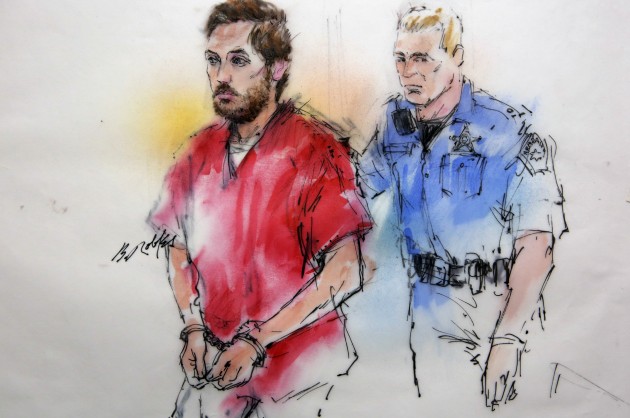
The preliminary hearing this week for James Eagan Holmes, the alleged shooter who murdered 12 and injured 58 during a July 20, 2012, rampage in an Aurora, Colorado movie theater, is once again raising questions about the insanity defense.
I suspect that the public often doesn’t understand a key point in insanity cases. The determining factor is not whether a person has a mental disorder or even the severity of his illness. It is whether his mental illness prevented him from being able to tell the difference between right and wrong.
Here’s my view on why that’s a poor standard.
“How Do We Define Insanity? First published on April 11, 2010
In 1980, he shot and seriously wounded a co-worker. Patterson believed his food was being poisoned by the man even though they’d only met that morning.
Three years later, Patterson wounded another man during a delusional assault.
In 1986, Patterson assaulted yet a third victim.
Finally, on September 25, 1992, just days after his brother had tried unsuccessfully to get him committed to a psychiatric facility, Patterson fatally shot a businessman and his secretary.
He then put his gun down, stripped to his socks, and paced, shouting incomprehensibly until the police arrived. 
There was no doubt that Patterson had committed two murders.
There was no doubt that he had a severe mental illness and was delusional at the time of the murders.
Did that mean he couldn’t be held accountable for his actions because he was legally ”insane?”
Most people believe that if someone is ”insane” when they commit a crime, they can not be held accountable for their actions. But our legal system always has had trouble dealing with persons with mental illnesses and the Patterson case is the perfect example.
First a short history lesson.
In 1843, an Englishman named Daniel M’Naghten fired a pistol at the British Prime Minister, but instead hit one of his aides who died five days later. The House of Commons appointed a panel to decide when someone was so “insane” that they were not legally responsible for their actions. They came up with what is called the M’Naghten ruleand it is still the basis for nearly all of our laws that deal with mental illnesses. The key part of the rule states:
“to establish a defence on the ground of insanity, it must be clearly proved that, at the time of the committing of the act, the party accused was labouring under such a defect of reason, from disease of the mind, as not to know the nature and quality of the act he was doing; or, if he did know it, that he did not know he was doing what was wrong.
Now, back to Kelsey Patterson.
Did Patterson understand that what he had just done — committed murder – was wrong?
Psychiatrists for the prosecution testified that Patterson did understand that murder was wrong when he committed the killings — so a Texas judge ruled that Patterson could be found guilty and given a death sentence. What happened next is rather extra-ordinary.
In only the second time in its history, the Texas Board of Pardon and Paroles sent a recommendation to the Texas governor asking that Patterson’s life be spared. By a 5-to-1 vote, the panel said Patterson deserved mercy because he was simply too sick to be punished.
The governor, Rick Perry, ignored that recommendation. In a statement, he wrote:
“This defendant is a very violent individual. Texas has no life without parole sentencing option, and no one can guarantee this defendant would never be freed to commit other crimes were his sentence commuted. In the interests of justice and public safety, I am denying the defendant’s request for clemency and a stay.”
On May 18, 2004, a clearly delusional Patterson, still rambling incoherently, was put to death.
This case outrages me for several reasons.
*Why wasn’t something done about this man before he murdered two innocent persons? He had a long history of mental illness and violence — more than two decades of warnings. Did we really expect that he would somehow heal himself?
*The governor’s reasoning is cold-blooded and it completely ignored the fact that Patterson had a severe mental illness. The governor said Texas couldn’t lock him up forever and couldn’t keep the public safe so the only alternative was to kill him. How about actually treating him? How about sending him to a forensic hospital?
*We have learned many things about the brain since 1843. The DSM differentiates between anti-social behavior and schizophrenia. Yet, we are still basing our insanity laws on antiquated information. The courts need to re-think the definition of insanity. (One change that would help is to put an end to the use of psychiatrists-for-hire. Rather than having the defense and prosecution hire psychiatrists who make their livelihood either testifying that someone is sane or insane, a judge should hired three psychiatrists and have them report to the court. This also would cut back on having attorneys using the insanity defense when their client is obviously guilty and they don’t have any other rational explanation to fall back on. Such cases are an insult to persons who have legitimate brain disorders and increase public stigma.)
*The U.S. Supreme Court’s current practice of focusing on whether a defendant knew the difference between right and wrong shows a lack of knowledge about mental illnesses. In Miami, I met a man who believed that he was possessed by a devil. He began chewing through his own skin and hit an artery because he wanted to cast out the devil.
Now let’s assume that this man believed that a stranger had been possessed by the devil so he fatally shot the stranger. Did he know murder was wrong? Absolutely, but he also knew that the devil was inside that man and that was who he was killing.
The questions that I am raising in this blog are important because there are currently more than 200 Kelsey Pattersons on death row in America.
Recently, the U.S. Supreme Court ruled that persons with mental retardation can be exempt from execution because of their obvious diminished culpability. It’s time, I believe, for the court to extend that same reasoning to persons with legitimate mental disorders.

 About the author:


Having worked as a bilingual teacher for the NYS dept. of corrections for 32 years, I agree that the courts need to recognize the diminished culpability of persons with severe, chronic and persisting mental illness.
The problem here is that said individuals should be treated in forensic hospitals where mentall illnesses of the criminally insane are better understood.
Sending the mentally ill to state prisons often exacerbates the illness due to improper treatment and the use of inferior or sometimes ineffective psychotropic medications. Since the prisons today have become the mental asylums for the criminally insane, treatment modalities and medications are subject to the budget. They also become victims of the predatory habits of other more dangerous and depraved inmates.
When these individuals do not receive the proper treatment and medications, they become a present danger to the men and women working in the facilities. Not only are guards in danger but often civilians and fellow inmates who have just as much or MORE contact time are placed in harm’s way. Another problem occurs when prison workers have not received adequate training regarding mental illness.
When I started teaching in a NYS maximum security prison, it was a common occurrence for individuals with severe mental illness to be mainstreamed into general population. It was almost impossible to maintain any kind of semblance of order when two or three individuals with mental illness were placed in class. Their behaviors were disruptive and threatening to other inmates in the class. Teachers were told to do the best that they could until “they went off”. When they “went off” like ticking time bombs do, they were escorted to the psychiatric unit where they often received a shot of Thorazine and then were sent back to programs. It was fortunate indeed IF no one suffered any adverse consequence from an incident when a mentally ill person exploded.
Today the department offers a short segment in their mandated training for officers and civilians concerning inmates who are mentally ill. In my opinion, it is NOT adequate.
Men and women who have a serious mental illness should not be sitting on death row. They have the right to treatment in appropriately designated correctional facilities that house ONLY those with severe, chronic and persisting mental illness. We should not be warehousing people like perishable goods that have an expiration date…that date being the day of their execution.
Does the insanely drunk alcoholic who blacks out while driving, killing a pedestriasn receive the death penalty? Never.
Do U.S. soldiers who recklessly kill women and children while under orders
to fight an insane war get the death penalty? Never.
Do doctors and mental health clinic directors who are negligent to the point of malpractice in denying adequate health care, thereby creating murderers among their patients, get the death penalty? Never.
Do employers, neighbors, teachers, media employees and all others who
stigmatize the mentally ill by not hiring them, befriending them, empowering them, and in short, marginalize them to the point they end their lives thanks to the wretchedness others have made it, get the death penalty? Never.
Is the law fair? No.
No one who is sick and doesn;t know it, or newly sick and not managing it yet, should EVER be held accountable for as much as spitting on the sidewalk, let alone murder.Sick referring to treatable mental illness. FYI – -mental illness can kick in within an average normal person in a matter of days, hours. Plenty of documentation on it. Holmes and Lauffner are young men VERY inexperienced with their own mental illnesses. Regardless of treatment, personal opinions about their crimes, premeditation, or the right and wrong bull__. THEY were SICK when they did what they did. Ted Kaczinski (unabomber), has a brother who is very active in these justice matters. Ted, who has schizophrenia, BEGGED for help by writing letters to the mental health agency near his cabin in the backwoods where he was hiding, confused and decompensating. Mentally ill people don’t forget how to make bombs, play music, or ride a bike, just because they are psychotic.
Stupid judges and the ignorant in law practice fail to see right and wrong have
NOTHING to do with INSANITY!
I’ve been hearing about the mentally retarded being put to death since I was a kid.
How disgusting that its taken this long for that to be looked at.
Any country that executes people who have a definable illness that puts them, involuntarily into a state of psychosis, where they commit crimes that to their normal selves are repugnant, is a country in deep moral trouble.
Key – crimes commited while seriously ill. If a person w/ mental illness is in
remission, its a whole different story.
Will be interesting to see who wins the Holmes case.
The stigmatizing hateful public spurred on by pumped-up police depts.
or the American conscience
You can bet that the American Psychiatric Assoc., who could turn this around in a heartbeat,will shirk their hippocaratic oath and crawl away as the cowards they have been.
.
What does it take to challenge this antiquated definition of insanity and change the law? What are the first steps to take? Can this be presented in a case to the Supreme Court or something?
Usually Supreme Court rulings are overturned ( Roe vs. Wade), through class action suits, or lawyers argueing the case. “What it takes to challenge’ would be media attention, large majorities of people speaking out, and constant pressure on the courts to review the issue.
For ‘steps to take’ I would suggest consulting an attorney, or visiting a law library or googling on Supreme Court actions.
Any controversial issue the high courts review ( abortion, discrimination, church and state conflicts, ) needs dedicated people in support who will substantiate (prove) that their view is the right and preferred one.
Speaking to your state and federal elected representatives is a good place to start. Just as important, is to bring your passion to awareness by talking to others, and educating, where possible, to dispel archaic middle-ages notions on mental ilness.
There are groups that routinely show up for protest at executions. You may want to explore that, as well.
I am guessing it may be more realistic to reform the insanity defense, than to tackle the death penalty. In a largely Christian leaning
country, the eye for eye runs strong, and people willfully mistake vengeance for justice. But the love and compassion toward the sick, another Christian principle, may serve useful once mental illness is revealed as a ‘no-fault’ state of mind, etc.
Hope this helps~
The problem is that the current Supreme Court has no interest in liberalizing the use of psychiatric testimony or the insanity defense. See their opinion in Clark v Arizona (2006). This past November they refused to hear Delling v Idaho in spite of a brief in support by the American Psychiatric Association and the American Academy of Psychiatry and Law. States generally have been restricting or modifying insanity pleas: creating GBMI (guilty but mentally ill) pleas that lead to a joint DOC/DHMH commitment, for example.
There are situations where a person is so psychotic that they do not know that what they are doing is wrong, and I do not believe they should be held responsible. But, we also cannot assume that just because someone has a severe mental illness they have no control over their actions and/or no awareness that what they are doing is wrong. Some do. I’m not going to comment on the specific case above, because I don’t know all of the details.
People with mental illness are just people, most good, some bad. My understanding is that some of those who commit mass murder besides having severe mental illness are also psychopaths. Perhaps it’s the psychopath part that makes them kill, not the depression or bipolar disorder or whatever else. There is a difference between someone who commits a crime due to psychosis and someone who commits a crime because they are a psychopath.
The knee jerk reaction in the media to immediately explain Adam Lanza’s actions as the result of mental illness have done those with mental illness a huge, huge disservice. We do not know if he committed the crimes he did because he had a mental illness or because he was a hateful person who unleashed his rage on society. It’s important to know the difference.