“I hate being bi-polar, it’s awesome”
-Ye
There is a moment in the 2022 Kanye West documentary, “Jeen-Yuhs: A Kanye West Trilogy” that struck me personally very hard. Kanye, or “Ye” as he prefers to be addressed now, was surrounded by some of his close advisors and inner circle. He was clearly in the midst of a psychotic break, a manic phase punctuated by lucid, unrestrained thoughts and rambling word salad. I am very personally familiar with that experience, as documented in my father’s work.
The moment that stood out to me, was when he looked at his entourage and told them that none of them knew what it was like to be arrested, handcuffed, and taken from his home due to his illness. How I wish I was there!!! Perhaps, as I do with my peer work, I could have averted the various crises that happened since that moment!!! I know what that experience is like, because it happened to me. How I wish I could have normalized his experience and consoled him during this fragile time.
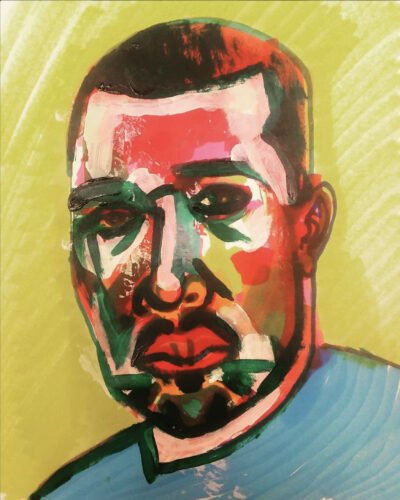
I drew the portrait of Ye above in 2018. At that time, I thought perhaps Ye has one of the best catalogues in hip-hop and music. As a rapper/producer myself, one who lives with serious mental illness, I felt a close kinship to his work. He was the soundtrack for much of our lives, we grew up listening to him, and his successes felt like our own. He made what seemed like timeless music, won numerous awards, and seemingly cemented his status as a music icon. That was until he would go on to then squander all of the goodwill he had garnered for over a decade by an ever-increasing series of tragic and odd decisions of his.
He would go on to say horrific things such as “Slavery was a choice”, harass and demean his ex-wife and her lover, become an early advocate for President Trump’s “dragon energy” and embrace the red MAGA Hat, sell nazi imagery on t-shirts on his website, and release music with racial slurs and pro-Hitler lyrics. It seemed like every move of his was a calculated dumpster fire. These were serious and hurtful stances for him to take, and they were and still are abhorrent. At this point, I had all but written him off as a musician and a person. Once a beloved figure, I wanted nothing to do with him.
Recently, a close friend sent me a link to an apology that he wrote, which despite sounding like a press release and coming close to an upcoming album, he seems to be admitting that he lives with bi-polar, and that he is trying to come to terms with the hateful ideologies he has spewed and is seeking forgiveness.
It got me thinking. I know there are people in my live whom I have burned bridges with. People who will never forgive me for my behavior when I was manic, when I was untreated, before I sought help and was able to find the space and community to recover. When I said and did hurtful things, when I lashed out or did something horrible, I know that there are people out there who remember that behavior. The difference is, I am not one of the most famous musicians on the face of the earth. I know my father’s book and the Ken Burns documentary has given me a small bit of fame, but nothing like Ye’s realm that he navigates every single day.
I told another close friend that I don’t think I would be alive today, if I had Ye’s level of fame when I was sick and at my lowest.
So at what point do we forgive Ye? Is he Charlie Brown, pulling the proverbial football from us every time we go in for a kick? Does he do this for attention, every time he has an album to promote or roll out? Or does he genuinely want to seek help, to recover, to be well?
It’s an interesting question. I know many people, rightfully so, wrote me off a long time ago. How do we, as a recovery-oriented community, keep people’s recovery in mind when they do or say hurtful things? What is irredeemable? What are the limits of forgiveness? What can we blame on the illness, and how much of it is just bad behavior?
These are all questions people who love and care for those of us with serious mental illness must live with and ponder.

 About the author: