
Drawing of the author pushing shopping carts at his former job.
“See, I make moves and tell what’s the truth
That’s why I’m here, to be living proof…”
-Melachi the Nutcracker, “Livin’ Proof”, 1995
GROUP HOME
I first became aware of the concept of a “group home” when I bought an album by a rap group that called themselves GROUP HOME as a teenager. The name of the album is “LIVIN’ PROOF”. It remains one of my favorite musical albums of any genre. Little did I know that one day I would live in a group home.
The story goes that one of the teenage members of the group was facing criminal charges, and the group’s producer, DJ Premier, begged a judge to let him work on an album, even though the young man wasn’t really a musician at the time. The judge relented, and the young man known as Melachi the Nutcracker became a musician, as he rose to the occasion and avoided the jail time he was facing, and penned his rhymes that have captivated me ever since.
CHESS
Why do I call this blog entry, “BIG KEV FROM THE GROUP HOME”? It’s because when I used to play chess in Fort Greene Park as a student in college, there was a local chess player there who referred to me with this nickname he gave me. I guess he was some sort of fortune teller, as he knew what lay ahead of me on my path, years before I became sick. Maybe he was being sarcastic, as I was a young, impressionable man studying art at college, far removed from any group home that people like Melachi had to endure. It remains a mystery of my life.
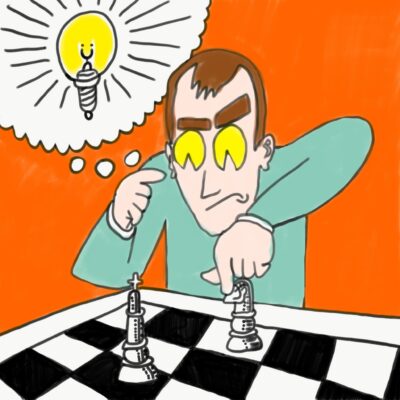
Self-portrait of the author playing chess
HOUSING
How about you? Have you ever lived in a group home? Was this ever your best option?
After years of burdening my parents with housing me, I yearned to live on my own. Cycles of unhealthy interactions with my parents would be hard to break if I continued to depend on them to house me. This led to literal fights with my dad, including one where I leapt from a moving vehicle. Arguments, misunderstandings, and differences of opinion all happen often when in close quarters with the loved ones we call family. How are they supposed to operate and thrive when I am acting like this?
With assistance from a wonderful case manager, I moved into a group home, part of a societal safety net for individuals like me, a chance for much-welcomed independence. I lived with one man who had severe schizophrenia, and he would shout in his room at night. Another one was a recovering alcoholic and crack user; he mostly watched television reruns in the living room while sipping Mountain Dew. I am bipolar/schizoaffective and was severely humbled and changed by my experience.
In my twenties, I was diagnosed with this serious mental illness. It uprooted a promising life path, sent shockwaves through our family, and sent me on a long detour, one that I am in the beginning of putting back together what’s left of my path, returning to form from the stages of pre-diagnosis. I lost some of the best years of my life to this illness, years I can’t ever get back, and an infinite amount of “what-ifs” will always remain.
I embarrassed myself, got serious legal charges, and inconvenienced many loved ones and strangers. I was sick, and after several years of run-ins with police, crash-outs, episodes, serious hospitalizations, and moments when I would go off my medicines and become psychotic, I finally decided it wasn’t a government conspiracy, or I wasn’t a prophet from God, or it wasn’t all a random coincidence, but that I needed help. I had to arrive at this moment by myself, and finally, I took the accountability to recover for myself and the harm I had done to others. Some people will never forgive me, and I am okay with that.
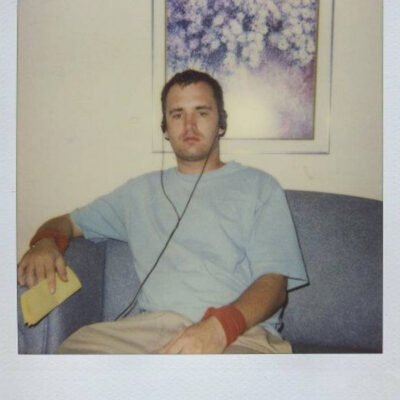
The author’s hospital intake photo, 2002.
I moved into a group home after my last hospitalization in 2008. After a few months where I lived with my mother after breaking my leg in a snow bank, I started my residence in the group home, and I was also unemployed at that time. I didn’t have any income, besides SNAP benefits, unemployment benefits, and general relief income. Thank God for social safety nets, the people who supply them, and who fight for them! They saved my life. Luckily, while I was unemployed, I only paid one dollar a month in rent. When I eventually became employed, it ballooned to one-third of my income, which was, at the time, about 300 dollars.
Have you ever looked at an empty refrigerator and wondered how you are supposed to feed yourself? Have you ever spent your last five dollars on dry spaghetti noodles or ramen because it’s the cheapest way to fill your belly until you can figure out how to get more money? Eating food that is cheap, unhealthy, and frankly, doesn’t taste very good, because it’s all you can afford, and going to bed hungry were not situations I was accustomed to as a person from my socioeconomical background, despite having some instances in college when I was a literal “starving artist”, I wasn’t really used to living like this, nor did I see it as my entire destiny, but for a moment, that was my entire reality.
SHOPPING CARTS
When I was finally able to get a job, it was the lowest of the lowest entry-level jobs. I pushed shopping carts at a hardware store chain. I worked in the heat and cold, retrieving carts and putting them back from the lot to the general store area. I was paid the minimum wage, $7.25 an hour, and I only worked 38 hours a week, so that the store didn’t have to pay me health benefits. Still, I was grateful to work.
It was an adjustment that changed and shifted your perspective to live like this. Several people live in situations like this in this country, though! It is not as uncommon as you might think! Our society seems to operate in a way where there are different tiers and different income levels within these tiers. Some people are considered to be “expendable”, and their needs and wants are constantly ignored, as are they. Some people profit from systems that speculate on necessities, like housing, clothing, and food. Access to the top tiers is very competitive and hard to attain. The good news is that those of us on the bottom tiers outnumber those of us on the top, who rely on our exploitation. Someone should write a book about these “Hunger Games”! Hard to pull up from bootstraps when you are barefoot.
Most people don’t think for two minutes about the mentally ill, unless, like my father, they experience it personally. I went from a promising, healthy, young college-educated white cisgender man (a supposed high rank in the established tier system) to a psychotic, mentally-impaired, and dangerous threat, in an instant. Luckily, I am one of the few who was able to somewhat recover despite my ailments.
PEER SUPPORT
I eventually became a peer support specialist and found my calling in that role. About five years after my dad’s book was published, I began to speak publicly about my experiences. About ten years after my dad’s book was published, I was approached by the good people from one of Ken Burns’ production companies to tell part of my story, along with over twenty other young people. Through using my own art, music, and interviews, we helped to launch the HIDING IN PLAIN SIGHT- YOUTH MENTAL ILLNESS film, which had a national premiere in 2022, the very year I finally moved into my own apartment, the same year we were invited to the White House. In 2020, I graduated from grad school with a master’s in social work from Virginia Commonwealth University.
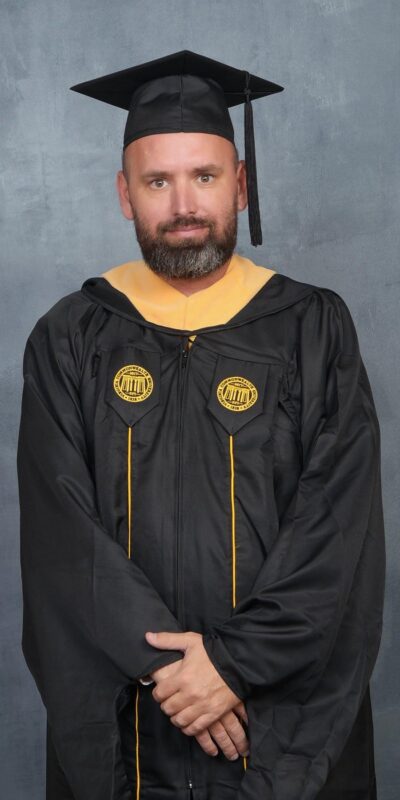
The author in 2020, after graduating from VCU
The story doesn’t end there, though. One of the hardest things in my life is being the “face” of recovery. Am I allowed to make mistakes, suffer setbacks, or relapse if I am supposed to be a champion of my own demons? It has been a hard-fought battle to arrive where I am now. I will detail much of it, along with others’ perspectives, in this blog. I want to maintain the integrity that my father established with his writing, while offering my own unique perspective on things. I hope you continue to take this journey with me.
Sincerely,
Kevin Earley a.k.a. “Big Kev from the Group Home”

 About the author: